Capitalizing on Market Dynamics Through Dryer Optimization
- WARNING: Resizehelper couldn't find requeted file: /var/www/vhosts/ethanolproducer.com/httpdocs/ethanolproducer.com/app/webroot/uploads/posts/magazine/939-1292253907.jpg
- WARNING: Resizehelper couldn't find requeted file: /var/www/vhosts/ethanolproducer.com/httpdocs/ethanolproducer.com/app/webroot/uploads/posts/magazine/940-1292253907.jpg
- WARNING: Resizehelper couldn't find requeted file: /var/www/vhosts/ethanolproducer.com/httpdocs/ethanolproducer.com/app/webroot/uploads/posts/magazine/941-1292253908.jpg


The plant was completed in eight months—an industry record—and produced its first gallon of ethanol in June 2005. A second industry record was set when the plant went from start-up to full production status in three days.
The Challenge
The United States continues to see record growth in demand for fuel ethanol, as more cities and states have adopted policies encouraging or requiring the use of ethanol in gasoline. Dry-grind ethanol production also produces distillers dried grains with solubles (DDGS) and/or distillers wet grains with solubles (DWGS), which are in demand as livestock feed. Due to the high protein content, distillers grains has been found to be an excellent feed product for livestock. Therefore, some ethanol producers choose to locate near large numbers of livestock so that the feed can be marketed locally. The production of distillers grains for longer-term storage and shipping, requires removing large amounts of moisture from ethanol silage, which requires more energy.
As the market for ethanol, DDGS and DWGS grows, manufacturers face great pressure to maximize production while controlling costs. Because even the smallest variables in the complex production process can impact yield, marketing time, operating cost, and profit margin, ethanol producers must constantly balance market dynamics with operational efficiencies.
What is Model Predictive Control?
Companies use a variety of different process automation technologies and strategies to control their processes and improve their business performance. The most common approaches are regulatory control and Advanced Process Control (APC). The APC acronym came into prominent use in the late 1960s and initially referred to any algorithm or strategy that went beyond classical proportional, integral and derivative (PID), or ratio control. Today, APC encompasses a variety of control technologies and methods such as supervisory, inferential, feed forward, adaptive, multivariable, nonlinear and model predictive control. Some APC applications incorporate several of these elements while others exclusively focus on one particular aspect. Technologies such as fuzzy logic, expert systems, neural networks, statistics and rigorous models often form the basis for APC applications.
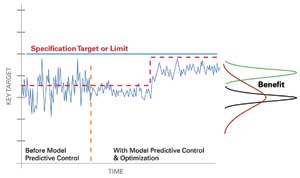
Model predictive control (MPC) uses a reference model of the process to predict future process behavior and calculate an optimum set of control moves that minimize the deviations from the desired control objective (Figure 1). MPC is a software solution that sends process set-points to the distributed control system (DCS) or programmable logic controllers (PLC) every minute to reduce process variability and ensure the production process stays on target to meet desired business results.
Over the past several decades, multivariable MPC has become the prevailing technology in APC—so much so, in fact, that the terms are often used interchangeably. Currently, the use of large-scale MPC is widespread throughout the process industries. ARC Advisory Group, which specializes in manufacturing and supply chain solutions, estimates that there are about 10,000 MPC applications with the number of applications climbing rapidly.
What Does MPC Mean for the Ethanol Industry?
As the ethanol market continues to grow and demand increases, manufacturers must struggle to quickly meet that demand while at the same time operating in a cost-efficient and environmentally responsible manner. MPC allows an ethanol manufacturer to optimize process units, like fermentation or distillation, or their entire production process to increase production, reduce energy costs, improve product quality and increase yield.
Capacity Building with Pavilion Technologies
Soon after it began operations, the forward-thinking team at East Kansas Agri-Energy began looking for ways to maximize production capacity and efficiency at its dry-grind ethanol plant. Specifically, the team wanted to increase dryer capacity, decrease energy costs, increase DDGS moisture (and yield) and increase ethanol production through more stable beer column operation.
The team turned to Pavilion Technologies, a recognized leader in MPC technology and environmental solutions in the ethanol industry. Pavilion's Ethanol Solution leverages the company's registered Pavilion8 software platform and MPC technology. With Pavilion's Ethanol Solution, ethanol companies can improve operational performance for desired business objectives while maintaining regulatory compliance.
Using Pavilion's trademarked ValueFirst customer engagement methodology, East Kansas Agri-Energy first worked with Pavilion engineers to clearly define requirements, clarify expectations and identify anticipated benefits. The project parameters included optimizing the plant's evaporator, dryer and thermal oxidizer.
Pavilion implemented its Ethanol Solution to optimize dryer performance by predicting and controlling moisture. The solution utilizes a multivariable, nonlinear controller that is used to generate and execute dynamic optimization and control. Its continuous process control is able to maximize East Kansas Agri-Energy's dryer production 24 hours a day, seven days a week to yield the highest possible returns with the plant's current equipment configuration.
The controller is designed to shift drying load from dryer to evaporator. It is also customized to reduce heat loss in the thermal oxidizer hotbox, resulting in a decreased need for natural gas. It controls the thermal oxidizer's process steam header pressure and the syrup evaporator (including syrup solids and steam consumption) in the beer column to manage and stabilize beer column separation with the residual evaporator steam. Pavilion also customized the East Kansas Agri-Energy MPC solution to allow for higher average DDGS moisture, which increases yield.
Results Exceed Expectations
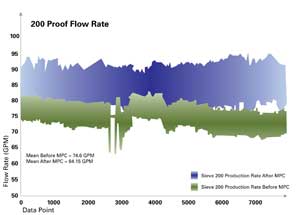
As a result of implementing Pavilion's Ethanol Solution, East Kansas Agri-Energy increased production by 12.8 percent. The solution also allowed the plant to significantly reduce its energy usage, resulting in a 9.9 percent increase in energy efficiency.
Pavilion's MPC solution enabled East Kansas Agri-Energy to achieve the following key benefits:
--12 percent increase in ethanol production
--12 percent increase in throughput
--9.9 percent increase in energy efficiency
--3.3 percent reduction in standard deviation in dryer moisture
"The results we have achieved with Pavilion have far exceeded our expectations," said Doug Sommer, plant manager for East Kansas Agri-Energy. "Pavilion's ethanol control solution has given us the edge we need to boost our production capacity with minimal additional investment in plant equipment."
The team estimates the total value of the MPC installation is more than $2.5 million per year (based on industry average marginal values and the cost of natural gas). The impressive project results demonstrate the significant amount of capacity hidden in production processes that could be readily available with the right process control solution.
As the ethanol market continues to grow, and more government mandates are put forth, companies must look for ways to quickly respond to customer demand in order to be successful. Companies must pursue strategies to capitalize on these dynamic market conditions, and MPC represents a proven technology that can deliver rapid results for a fraction of the costs of alternatives. EP
Michael Tay is a technical account manager at Pavilion Technologies. With more than 30 years of experience in the process industries, Tay has helped leading biofuels manufacturers consistently improve the performance of their plants. Tay is an expert in the field of model predictive control and optimization, specializing in drying, distillation, energy and fermentation. Reach Tay at mtay@pavtech.com or (512) 438-1400.


0 Responses
Leave a Reply
Comments are closed